


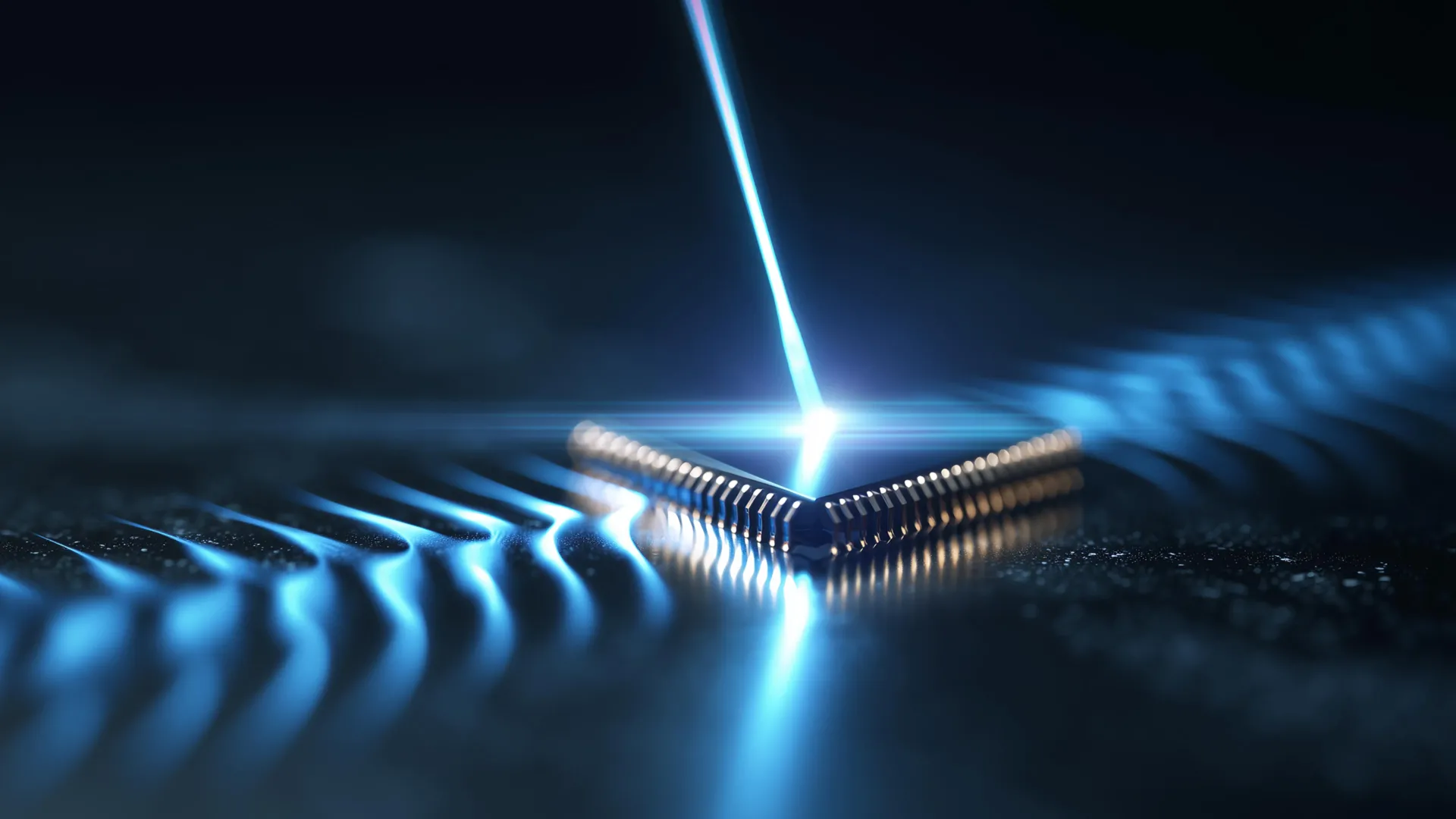
Researchers have made a significant breakthrough in sensing technology with the development of a “phonon laser.” Unlike traditional lasers that use light, this device uses sound vibrations at quantum scales. Experts say it could enable ultra-precise measurements and open new possibilities for advanced sensors.
Phonons are quantized sound vibrations that exist at the atomic and molecular level. By controlling these vibrations, scientists can create highly precise energy waves similar to how conventional lasers manipulate light. This technology could revolutionize measurement, detection, and signal processing in a variety of fields.
The phonon laser has potential applications in ultra-sensitive sensors, precision instrumentation, and quantum computing. Researchers believe it could detect minute changes in temperature, pressure, or chemical composition that were previously impossible to measure accurately.
Early experiments show that phonon lasers can produce coherent sound waves with remarkable stability. These waves interact with materials in predictable ways, allowing scientists to probe structures at the nanoscale. This could lead to breakthroughs in materials science, electronics, and medical diagnostics.
One of the major advantages of phonon lasers is their ability to operate at quantum scales. By using vibrations rather than photons, the device can measure extremely small forces and displacements. This opens opportunities for next-generation sensors that surpass the limits of conventional technology.
The development also has implications for quantum computing. Phonon lasers could be used to manipulate qubits or enhance the precision of quantum systems. As researchers continue to refine the technology, it may become a key tool in building scalable, high-performance quantum devices.
Industry experts highlight that this innovation represents a new class of laser technology. While optical and microwave lasers are widely used, phonon lasers operate in a unique regime where sound waves control energy transfer at the atomic level. This could create new possibilities in scientific research and industrial applications.
The research team is now focused on optimizing efficiency and control. By improving the stability of phonon emissions and integrating the device into practical systems, they hope to make the technology commercially viable for precision sensing and measurement.
Phonon laser sensor technology could also impact healthcare, environmental monitoring, and defense. Devices based on this innovation may detect microscopic changes in biological samples, track subtle environmental shifts, or enhance imaging systems for security purposes.
Experts agree that the phonon laser represents a step forward in bridging quantum physics and practical technology. By harnessing quantum sound vibrations, scientists are pushing the boundaries of what is measurable and achievable in sensing and precision instrumentation.
Overall, the development of phonon laser sensor technology demonstrates how advanced physics can create practical tools. With applications ranging from quantum computing to high-precision sensors, this innovation promises to reshape multiple industries and enable measurement capabilities never seen before.
