


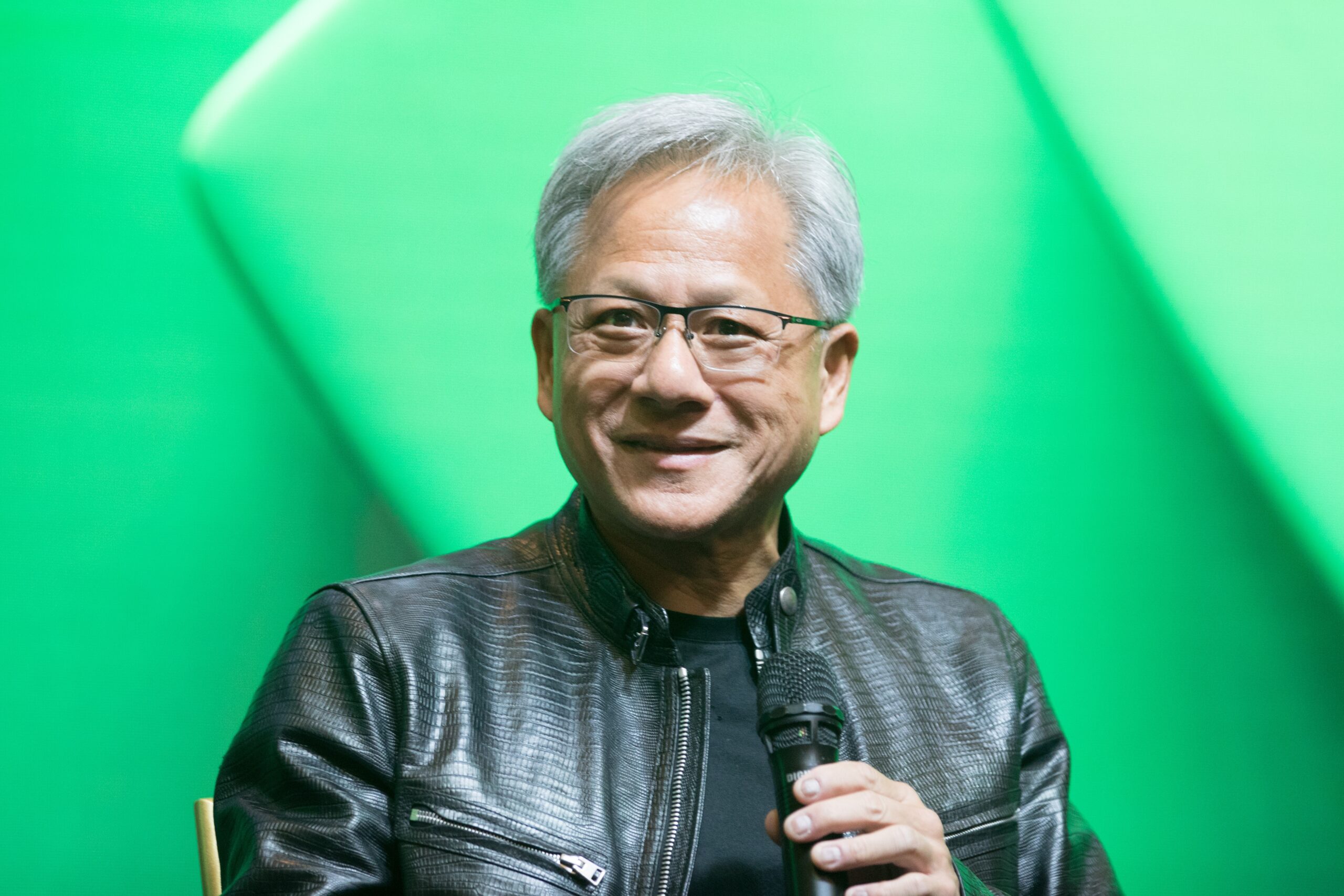
Nvidia has reported record revenue as artificial intelligence drives unprecedented demand, even as political tensions threaten its future.
On Wednesday, the Santa Clara-based chipmaker announced $46.7bn (£34.6bn) in second-quarter revenue, up 56% compared with the same period in 2024.
Despite the strong performance, shares fell in after-hours trading after executives admitted the company was still “working through geopolitical issues.” Nvidia remains caught in the trade dispute between Washington and Beijing.
Rapid policy changes under the Trump administration, aimed at keeping the US ahead in artificial intelligence, add further uncertainty for the company.
Tech giants fuel AI boom
Nvidia’s advanced chips are at the center of the global AI surge.
The company reported strong demand from major technology players, including Meta, owner of Instagram, and OpenAI, creator of ChatGPT. Both firms are racing to expand AI infrastructure.
“The AI race is now on,” said Nvidia chief Jensen Huang in a call with analysts. He revealed that four major technology firms had doubled annual spending to $600bn.
“Artificial intelligence will accelerate GDP growth over time,” Huang added. “We provide the infrastructure to power that growth.”
Analysts highlight Nvidia’s dominant market position. Colleen McHugh, chief investment officer at Wealthify, described the company as “the engine of the AI boom.”
She emphasized that Nvidia depends heavily on continued spending from tech giants. If investment continues, she said, revenue and share prices will keep climbing.
Revenue from data centres rose 56% to $41.1bn but slightly missed analyst forecasts. Investor Eileen Burbridge, founding partner of Passion Capital, said this weaker result caused the “share price wobble.”
Even so, she described Nvidia’s growth as “unbelievable” while cautioning that excessive enthusiasm could create a bubble.
In July, Nvidia became the first company in the world valued at $4trn. The firm now expects $54bn in revenue for the current quarter, surpassing Wall Street predictions.
Geopolitical challenges threaten expansion
Despite record results, Nvidia faces mounting political risks.
In July, the company announced plans to resume sales of high-end AI chips to China. The decision followed lobbying from Huang, who persuaded the Trump administration to lift its ban on the H20 chip, designed for Chinese buyers.
The ban had been introduced amid fears the chips could benefit China’s military and domestic AI sector.
Executives confirmed that by late July, US officials began reviewing licenses for H20 sales. Some Chinese clients received approvals, but Nvidia has not shipped the chips.
The US government expects 15% of revenue from licensed H20 transactions. Nvidia excluded the H20 from its forecast and is lobbying for approval to sell its new Blackwell chips in China, the world’s largest chip market.
Meanwhile, Beijing is accelerating efforts to expand its domestic semiconductor industry. “US export restrictions are fuelling Chinese chipmaking,” said Emarketer analyst Jacob Bourne.
He added that Nvidia’s long-term role as “the bellwether of the AI economy” may depend on whether its robotics expansion secures lasting leadership.
